Nude was never one colour but a negotiation between pigment, undertone and light, and the history shows who was allowed at the table. That record points toward ranges built undertone first and shade name second, tested on lips rather than hands.
“Anybody and everybody, no matter what generation, knows Spice lip pencil,” makeup artist Gregory Arlt says, and the memory lands because the pencil named an era. It reveals how narrow the definition of nude remained through the nineties, a matte brown lip that suited similar skin tones and left the rest of the market to improvise.
The archive helps explain why that narrowness lasted. The first commercial lipstick was invented in 1884 in Paris, made from deer tallow, castor oil and beeswax and covered in silk paper. In 1923 James Bruce Mason Jr. in Nashville, Tennessee patented the first swivel up lipstick tube. Those early formats made lip colour portable and repeatable, and by the late twentieth century the industry could set a trend through a single pencil or bullet. MAC Cosmetics Russian Red was the first-of-its-kind matte lipstick formula to market in 1985, according to Arlt. Madonna wore MAC Russian Red on her 1990 Blonde Ambition Tour, which helped popularize the modern matte red. Red proved that a matte texture could hold public attention. Spice then proved that nude could be merchandised as a brown matte with a defined lip line.
For darker skin tones, the nineties answer came from artistry rather than assortment. “Naomi set us straight with this in the early ’90s, with her Chestnut pencil and her C-Thru Mac lip gloss in the middle,” makeup artist Sam Fine says. Naomi Campbell set the early 1990s nude aesthetic for darker skin tones with Chestnut pencil and C-Thru Mac lip gloss in the middle. The method was brown liner plus gloss, depth at the edge and light in the centre, a way of building a nude where no single bullet existed. It worked on camera and on the street because it respected undertone and depth instead of asking one pink brown to do all the labour.
The next decade replaced the brown matte with shine. Stila lip glazes in twist-up pens, Lancome Juicy Tubes and MAC Lipglass took over in the 2000s gloss era. Jeanine Lobell says she created Stila glosses for Cameron Diaz on the set of the 2000 film Charlie’s Angels as sheer with a slight tinge of bubblegum. That sheer pink beige became the new default nude, lighter and cooler than Spice, and again centred on light skin. Sheer coverage forgave some mismatch, which helped sales, but it also hid the undertone problem instead of solving it. MAC Ruby Woo was originally released in 1999 and had a resurgence after Rihanna wore it in the 2010s. Rihanna collaborated on RiRi Woo lipstick in 2013, which she wore on her Diamonds World Tour that year. Red remained democratic in a way nude was not.
Then opacity returned. Kylie Lip Kits first came to market in 2015 and made the matte over-drawn lip look explode. A long-wear liquid lipstick is a fluid pigment dispersion that dries to a film, while a bullet is a solid wax and oil casting. Isododecane is described as the workhorse volatile carrier that sets the film within roughly a minute after evaporation. Trimethylsiloxysilicate is an MQ silicone resin that dries to a hard hydrophobic network, where more resin means longer wear and drier feel. Matte formulas maximize pigment and silica and minimize oil for high transfer resistance, while gloss formulas reverse that balance for shine and cushion. The matte overdrawn nude looked sharp in photographs and lasted through long wear time, but transfer resistance came with a dry feel that punished lips already prone to texture.
Why pigment decides who gets a nude
The chemistry explains why some nudes read as lip like and others turn ashy or orange by hour three. Most nude to deep shades are blended from red, yellow and black iron oxides against white titanium dioxide, with mica platelets adding pearl. Cosmetic chemist Javon Ford says the standard pigments in all color cosmetics are red, yellow and black iron oxides and white titanium oxide. That four pigment box can mix a serviceable beige, yet it struggles with the green, olive and blue shifts that keep deeper and cooler lips from looking flat. Javon Ford says larger manufacturers like L’Oreal may have access to other pigments like green and blue ultramarine to achieve more diverse undertones. Access matters. Undertone, meaning the cool, warm, neutral or olive cast beneath depth, is not a marketing story here. It is a pigment limit.
Dispersion matters as much as selection. Finer well-dispersed pigment reaches target opacity at lower pigment load because it scatters and absorbs more light per gram. Pigment load means the amount of colour solids in the formula, and opacity means how fully that film covers lip colour. A well milled nude can cover without feeling heavy. A poorly milled one needs more solids to reach the same payoff, meaning the colour payoff on first swipe, and the extra solids can drag, settle into lip line and emphasize dryness. Iron oxide red has density near 5.25 g/cm3 and titanium dioxide sits between 3.9 and 4.2 g/cm3, while isododecane carrier is well under 1 g/cm3, creating settling risk. In a liquid nude, heavy pigments want to sink in a light carrier. Without careful suspension, the shade in the tube is not quite the shade on the mouth.
Finish changes the reading too. Mica adds pearl, silica blots light, oils add cushion and shorten wear. A gloss nude that looked like bubblegum on Diaz in 2000 would have relied on low pigment and high oil for that translucent effect. A matte nude from 2015 relied on high pigment and silica for opacity and wear. Neither approach is wrong. The error is treating shade names as interchangeable across those textures. A beige that balances in a wax bullet can look pale in a liquid film because the film is thinner, cooler and less forgiving of undertone mismatch.
By contrast a beige that balances in a bullet can look pale in a liquid film.
The retail lesson behind the shade extension
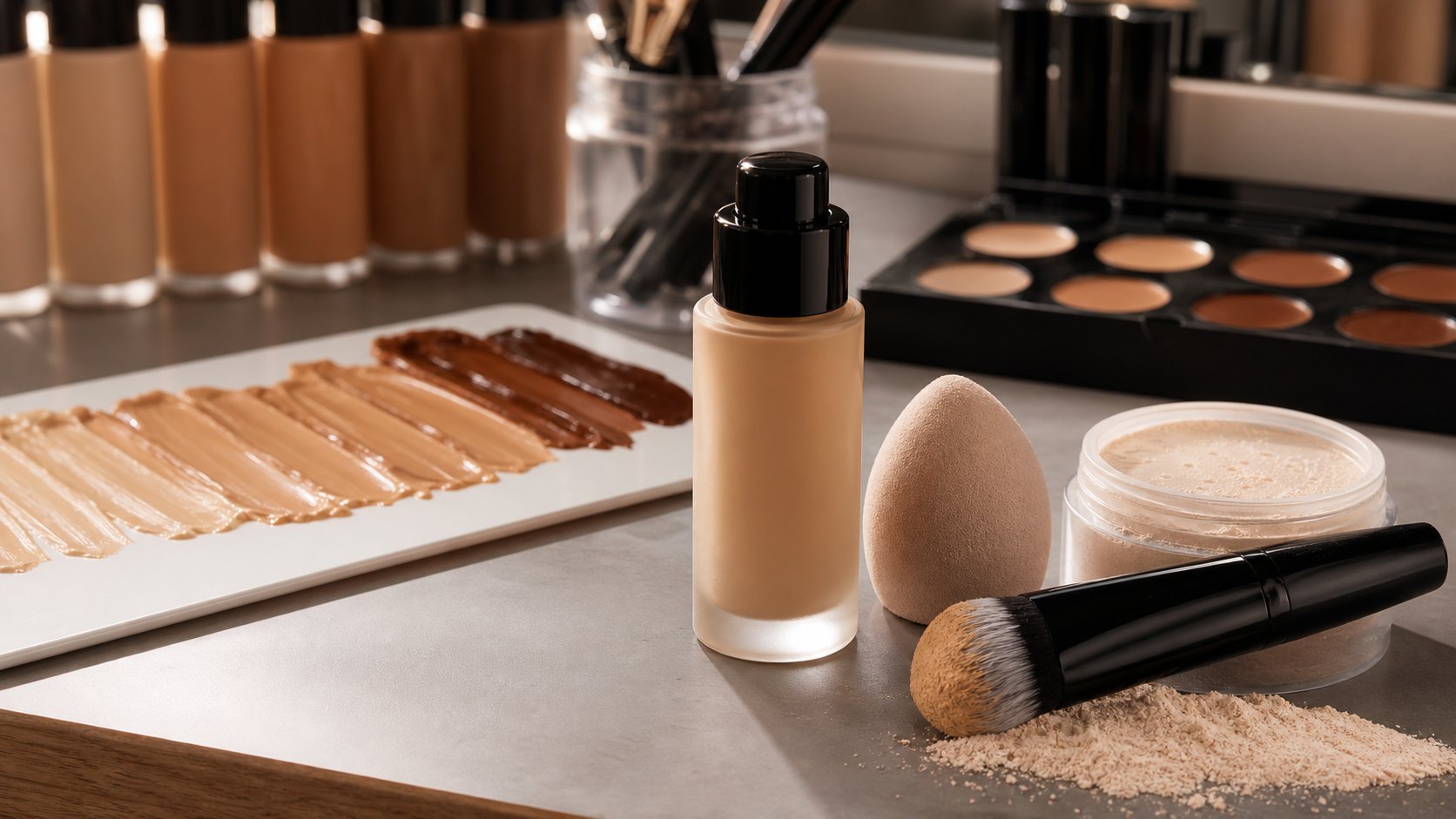
Fenty Beauty launched in 2017 with a then-unheard-of 40 shades of Pro Filt’r foundation, setting a new standard for shade range. Shade range means the full span of depth and undertone a brand offers, and shade extension means added colours intended to fill gaps in that span. The foundation moment reset expectations for lips by association. If base could arrive with forty starting points, a six shade nude library with three light warm beiges and one deep brown could no longer pass as complete.
The money argument followed. Black consumer spending reached 9.4 billion dollars in 2023 and outpaced total U.S. dollar household growth, which argues against skipping deep shades. Sell-through, the rate at which stock sells compared with stock received, rewards ranges that include deep neutrals with correct undertone. Doors, meaning retail locations carrying a line, cannot reorder what was never developed. Restock and waitlist tell the same story from opposite ends. A waitlist signals demand concentrated on too few shades. A clearance bin often signals the reverse, too many near identical light beiges competing for the same buyer.
“I started creating beauty content because I couldn’t find myself in the beauty space,” content creator Golloria George says. The sentence carries retail weight because swatching on hands remains the industry shortcut and hands mislead. Lip tissue is more pigmented, more purple and more variable than the back of the hand. A nude swatched on skin can look neutral and then turn ashy on lips because white titanium dioxide lifts faster against mucosal red. “An inclusive shade range doesn’t just mean checking off boxes from fair to deep, it means taking the time to understand undertones, depth, and nuance across all skin tones,” George says. Depth means how light or dark a colour sits. Nuance means the small shifts that keep a medium olive nude from reading yellow and a deep cool nude from reading grey.
Sources celebrate expanded foundation and color ranges, yet note brands lost momentum after 2020 and still stack ranges toward light and medium yellow tones. That stacking is visible on the shelf. Warm light beige repeats, medium olive arrives late, deep neutral with low white content arrives last if at all. Celebrity history reinforces the skew. Nude history is told through celebrity wearers, which centers who was photographed rather than systematic wear testing across undertones. Campbell and Diaz and Rihanna each moved product, but photographs do not substitute for wear testing across lighting, camera flash and eight hour wear.
What remains missing is practical. Which specific nude shades sell through versus sit at retail, by undertone and depth, is not stated. Backstage methods for mixing nudes for camera and lighting are not described. How allergy safe or mineral lip formulas change texture, wear or nude color is not explained. Whether lip swatching predicts purchase satisfaction better than hand swatching remains untested. The gaps point to the same need. Retail buyers track reorders by shade, artists mix to correct undertone under lights, and formula chemists adjust resin and oil for comfort. Those three sets of notes rarely appear together in a launch story.
A fair test would be simple. Apply the nude to bare lips, check it in daylight and warm indoor light, talk through it, drink water, revisit at hour four. For lips the vocabulary is payoff, finish, wear time and transfer, meaning colour delivery, surface effect, hours before visible fade and movement onto cups or masks. Dupe culture complicates the test because a colour match without the same dispersion and base will not wear the same. The cheaper twin may match in the tube and diverge on the mouth.
The position is therefore plain. A good nude range is built undertone first and shade name second, with depth extended honestly and white pigment handled with care. Brands that treat brown liner plus gloss as history rather than instruction will keep repeating the nineties. The better path keeps the artistry, names the undertone, mills the pigment fine, and asks buyers to swatch where the colour will live.

Heather Castellan
Heather looks after the brands Gloss Report works with and makes sure every sponsored page says so. She was a colour cosmetics buyer for seven years, which is where she learned how a shade range gets cut before it ever reaches the shelf.
More from Heather Castellan →