Rituel de Fille started with a red that would not quit and a rule that made everything harder. Three family founders in Los Angeles still mix small batches without synthetic pigments, and artists still reach for the pots at hour eight.
Los Angeles is where Rituel de Fille is poured, but the color started further south. Caroline and Katherine Ramos grew up in San Diego County, Michelle Ramos in the Bay Area, and the first idea came from carmine scattered wild across San Diego cactuses. That landscape red became a kitchen project around 2009, with Caroline and Katherine working on opposite coasts to build a rich lipstick from natural carmine alone.
It took about six years to get to market in 2014. Caroline brought fashion editorial kit experience, Michelle brought print and red carpet kit experience, Katherine brought writing and fine art and the chief executive role. The name means Girl Ritual in French, chosen for ceremony without being too literal.
What they sell now is spellbinding natural color that wears like magic. Pigment balms, eye soots, luminizers and lip oils, all formulated in house in their own Los Angeles facility, handmade in small batches, Leaping Bunny certified, free of synthetic pigments, parabens, phthalates, synthetic dyes and fragrances. The desk notices what buyers notice. The payoff is high for natural, the finishes stay dimensional under lights, and the shade stories are specific enough to create waitlists and specific enough to leave some shoppers waiting for extensions.
You talked about that first red since Caroline was twelve, then spent six years in kitchens before the 2014 launch. What did that carmine on San Diego cactus teach you about pigment load that a lab brief never could?
I will speak for all three of us here. That red is the reason we exist. Caroline and I had talked about a makeup line since she was twelve, and when we finally started, we were living on opposite coasts and working in small kitchens. We wanted a rich red lipstick made with only natural carmine, the kind you see scattered wild across the cactuses in San Diego. Pigment load, which is the amount of color packed into a base, is everything with carmine. Too little and it goes thin and pink. Too much and it drags and bleeds.
We learned to build slowly. We wanted to approach a naturals line from a magical, potion making standpoint, not necessarily the eco and green side. We wanted to bring in the ceremonial power that color has, while using a minimal and pure set of ingredients. There were definitely a lot of late nights where we thought, maybe this is not possible. There is a reason people do not formulate like this. That red took years because natural color needs a base that lets it stay saturated and still wear. When it finally held, we knew we had a line.
Your rule is no synthetic pigments and the fewest ingredients per color. What does that rule cost you in wear time and shade range, and where will you not bend it?
Michelle will tell you our test first. It had to wear well, look great, be different, and be natural. That sounds simple and it is not. Wear time is how long color still looks right before it fades or shifts. Without synthetics, every shade has to earn its staying power from the base and the mineral or plant color itself. Some brights will never be as bulletproof as a synthetic. We accept that.
Our feeling is that natural reasonably applies to ingredients that, if you had enough time and dedication, you could actually find in nature. We sought to create spectacular products with the shortest list of ingredients possible. We are 99 percent natural, with 1 percent or less synthetic paraben free preservative where safety requires it, and we formulate everything in house. No third party labs. If a shade needs a synthetic to exist, we do not make that shade. That limits the range, especially in vivid mattes and long wear brights, but it keeps the promise intact.
You all still make everything in your own Los Angeles facility in small batches. What does handmade mean on a restock week, when doors need units and a bestseller is close to a sellout?
It means we are the factory. We are small, entirely independent, one to ten people on paper and a tight bench of artisans in practice. We have been handmade in small batches since 2014. When Cult Beauty or the Detox Market or MECCA reorders, we do not call a contract lab. We schedule pours.
Sell through is what actually scans at the register, doors are store locations, and a restock is only real when units land. Our sell through can outrun our pour capacity, and that is the tradeoff. Small batches keep texture and color consistent in our hands, but they do not scale like outsourcing. We would rather go short for a week and keep the batch right than push a batch that changes the finish. Artists notice when a crème turns. They notice transfer, which is color moving onto cups or collars, and they notice if hour eight looks different from hour one. So we hold the line and communicate. Waitlist is not a strategy for us. It is the math of hands and pots.
Rare Light in Phosphene won Allure Best of Beauty in 2017, then came Lunaris and Solaris. What did that luminizer teach you about finish, the way light sits on skin versus shimmer sitting on skin?
Finish is the end look, dewy or satin or metallic, and ours has to look like light, not glitter. Phosphene is a beige with a peachy blush shift, a soft iridescent radiance in a rich crème with jojoba, lanolin, castor oil, candelilla and carnauba waxes and beeswax. You dab it with fingers on cheeks, eyes, lips. Lunaris added a blue violet opalescence, Solaris a warm peach. Same idea. Translucent, not opaque.
Early on Catbird told us the finish felt elevated, and Fiona Stiles told Allure she had been obsessed for two years. That mattered because pros wear test under lights. A luminizer that looks wet in the pan can go dry or gritty on skin if the mica or titanium dioxide balance is off. We wanted it to melt and hold a sheen without emphasizing texture. It is still finger first. The warmth of the finger softens the waxes and sheers the pigment load so the shift reads as skin, lit.
Eye Soots are sold as shadow, liner and primer in one. How should a shopper actually wear Cultist, and what keeps a crème eye from creasing or fading by afternoon?
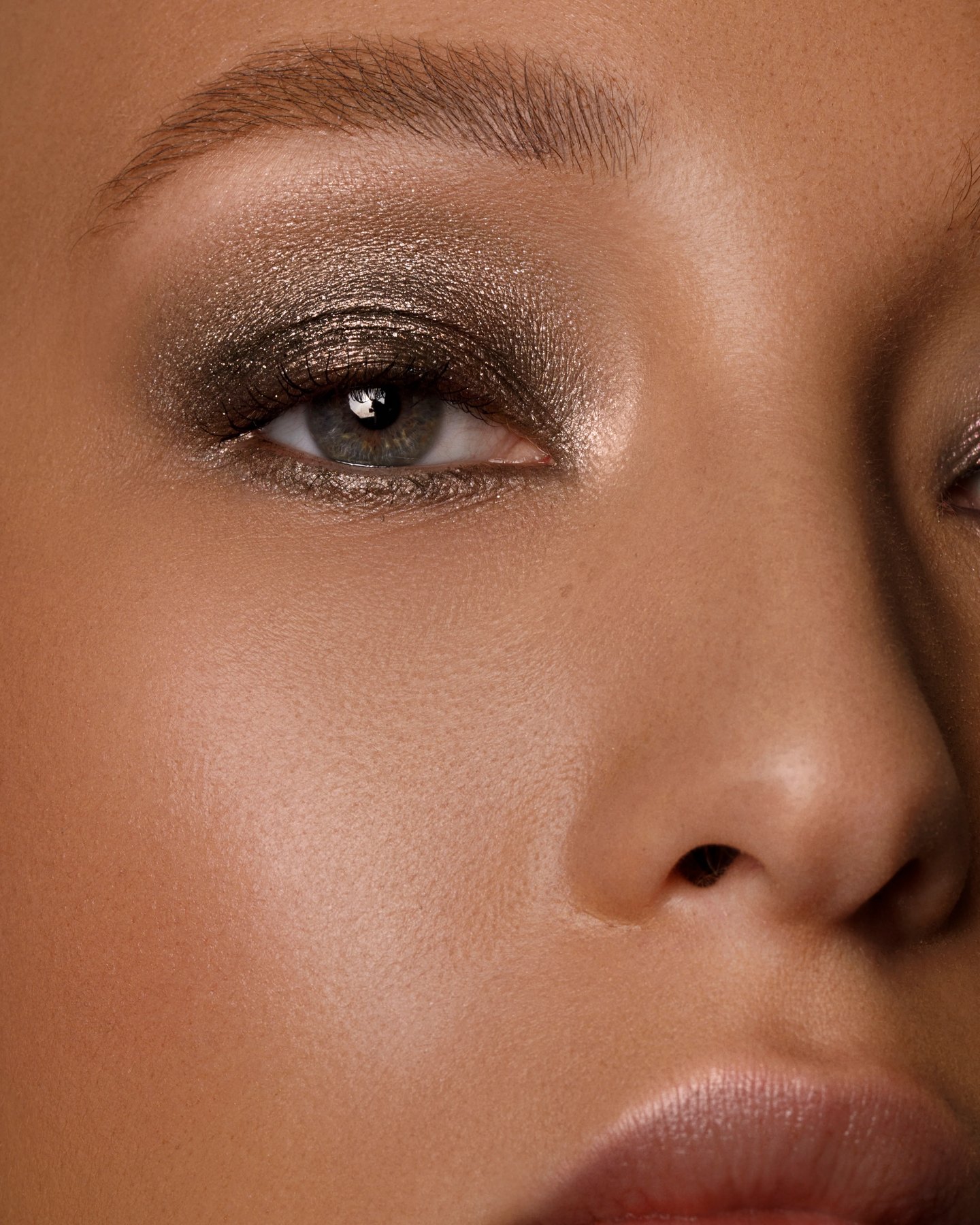
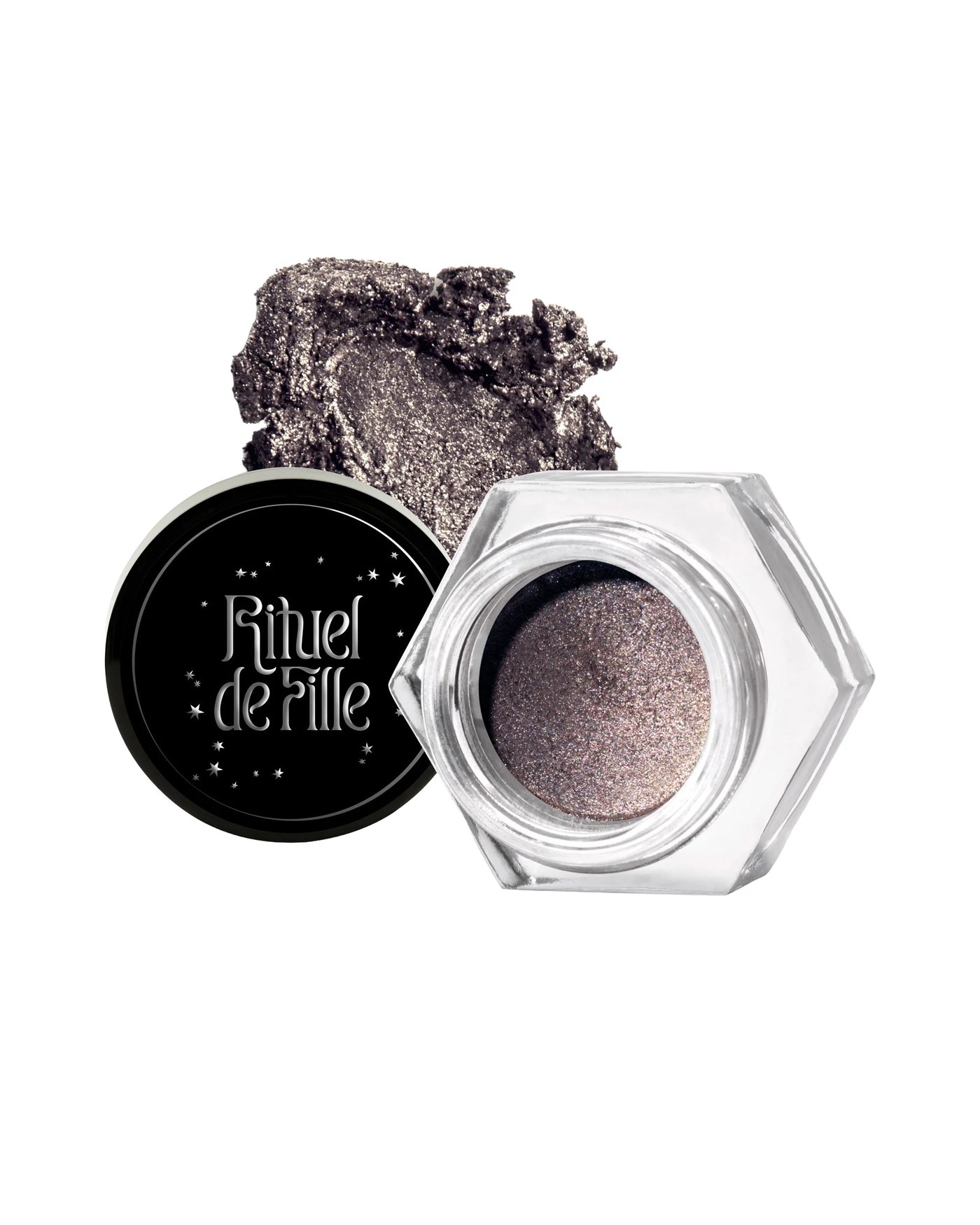
Michelle again, from the kit. You can mix and match, you can layer, you can put it where you want. There are no rules, just go for it. Cultist is our gray taupe with depth, a subtle gold sheen and translucent light capturing sparks. Use a small amount. That is the whole trick. Swipe in the pan, sheer it with a fingertip or our brush, let it set for a minute. For liner, push a thin line at the lash. For more smoke, layer while it is still moveable.
Creasing usually comes from too much product or oils underneath, not from crème itself. On very oily lids, keep skincare off the lid, set lightly if you need it, and build in thin passes. Our bases are short lists, so they do not have the synthetic film formers that lock some long wear shadows. What you get instead is a dimensional satin that still looks like skin at hour eight. If you want a sharp graphic line that survives heat and tears, pick a different formula. If you want depth that moves with the eye, this is the one.
You can mix and match, you can layer, you can put it where you want.
Michelle Ramos
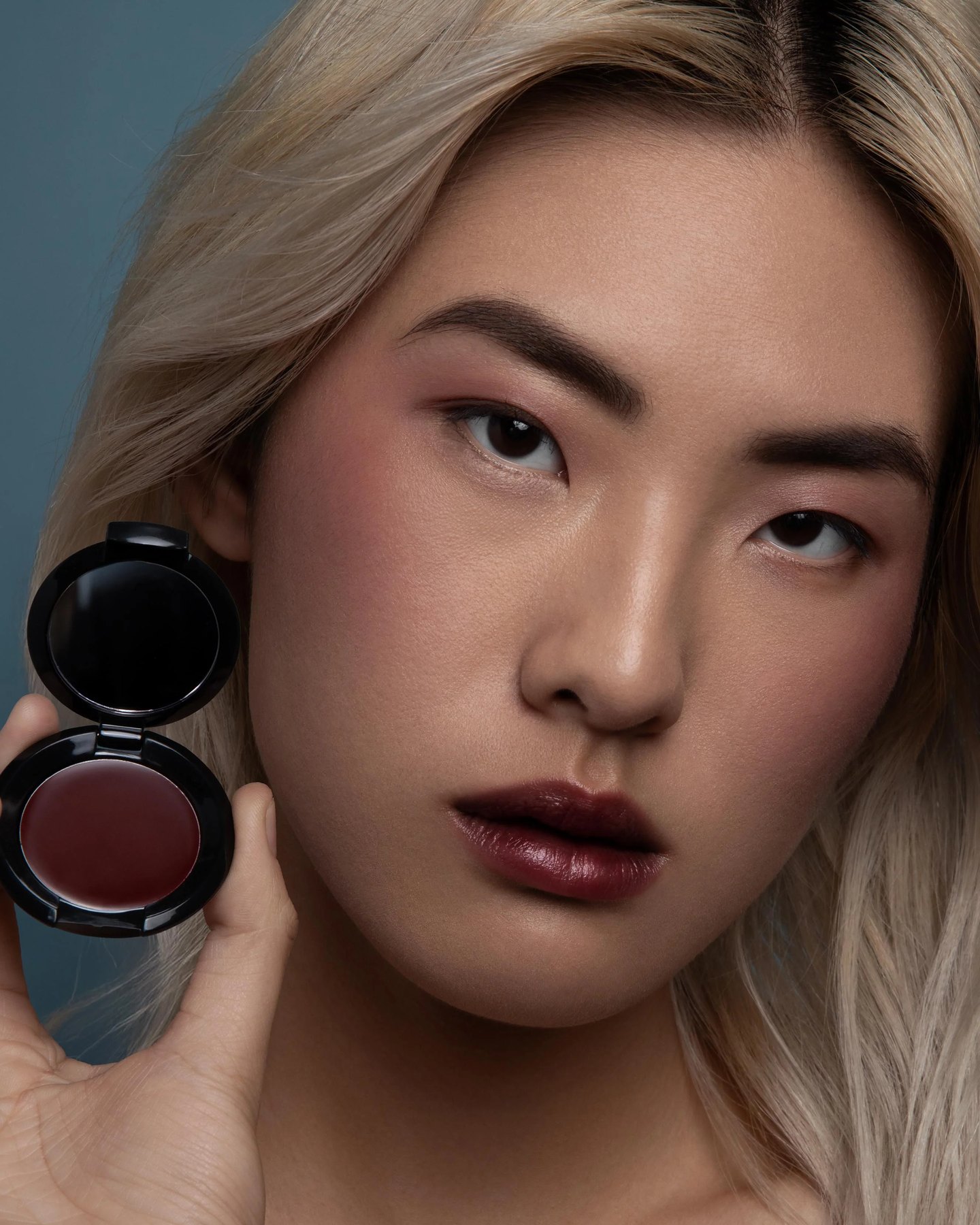
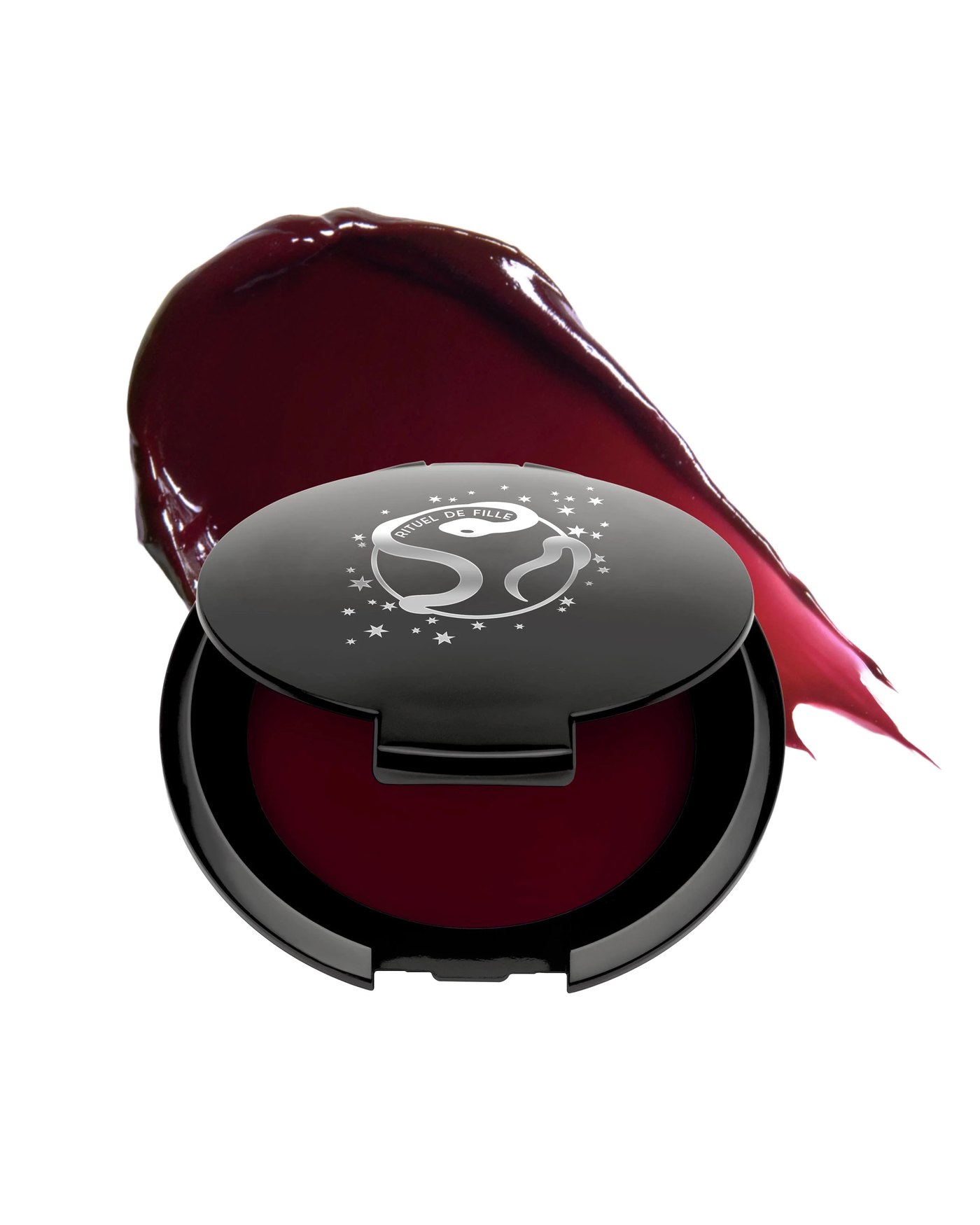
Color Nectar Pigment Balm in Weeping Cherry is translucent vintage burgundy for cheek and lip. Why does that sheer burgundy sell while a stronger version of the same idea might sit on the shelf?
Because sheer burgundy solves a real problem. It reads as crushed fruit and red wine, sipping from cut crystal, but it goes on like a wash. As a pigment balm it is meant for cheek and lip, pressed with fingers, layered for more depth. Translucency forgives undertone. Undertone is the warm, cool, neutral or olive cast under the surface, and burgundy can go muddy fast if it is too opaque on olive or too blue on fair rose.
A full strength burgundy asks for commitment and perfect prep. A nectar lets you build. First pass for a flush, second for evening. That is why it reorders. It is opulent without being fussy, and it photographs like a stain without acting like one. We want women to feel empowered by our makeup and try new things. A shade that lets you try twice in one mirror moment will always sell harder than a shade that punishes the first swipe.
Your line calls itself for everyone but not for just anyone, and your muse is a creative woman who adorns herself for herself. Who is actually buying, and which shopper is still left out of the shade range?
We love that line because it is honest. I think people have an immediate emotional connection to the authenticity and consistency of our vision. Our community grew like delicate mycelium, strange creatures hearing the same signal. The core buyer is a creative, magnetic, intelligent woman who adorns herself for herself. In practice that includes artists, enchanted minimalists, goths, brides who want real skin, and people avoiding synthetic dyes and fragrance who thought they had to give up artistry.
Who is left out. Fair question, and Gloss Report should ask it. Our complexion range is narrow. Three Drop foundation and Soft Sorcery concealer live in fair to light potions and spells, with rose, neutral, olive and gold distinctions, but deeper depths are missing. That is not a philosophy. It is a capacity and formulation limit we have to own. Natural pigments without synthetics make deep, flexible base shades harder to stabilize across undertones, and a small team can only validate so many shades at once. If you are deep, we are not serving you yet in base. Cheek, eye and lip are more inclusive by nature. Base needs extension.
Your packaging is black with the serpent and six pointed stars, and shades reference moonlight, predators and quartz. How much does story drive the reorder, and when does it get in the way of a shade match?
Story gets the first buy, performance gets the reorder. We craft beauty like spellwork, inviting all who seek magic to take part in the practice. Drawing inspiration from the dark, strange earth and the vast glimmering sky above, we created this to explore the magic of natural ingredients and the elemental power of pigment. That language tells you how to use it. Ritual, fingers, light.
But a name like Lunaris or Vitrum does not tell you if it suits neutral olive or soft rose. So we have learned to pair poetry with plain facts. Swatches on multiple tones, base color plus shift, finish and coverage in plain words. Phosphene is beige with peachy blush shift. Vitrum is silvery translucent prismatic quartz, vegan, for eye. The Chimera is lime blossom for a meadow nymph glow, site exclusive. If the story makes you pick it up and the description helps you choose correctly, you keep it. Returns drop. Reorders rise. If we only give you myth, you guess, you return, you do not trust us again.
If a buyer gave you three more doors tomorrow on condition of one change, what would you fix first to sell harder without breaking the spell?
Shade extension in base, with better sampling. We would keep the spell, the black compacts, the stars, the potion making, and we would add depth and clearer undertone mapping so more shoppers can find their potion on the first try. That means more true olive and deeper neutral options, and sachets or minis that let people test wear time at home.
We would also double down on education at the counter. Show the finger press for luminizer, the thin layer for eye soot, the two pass method for Weeping Cherry. Top notes and dry down belong to fragrance, but makeup has its own arc. Immediate payoff, then how it settles, then hour eight. Sillage in fragrance is scent trail. In color it is the trail you leave across a room, the cheek that still glows from the sidewalk to the table. Teach that arc in thirty seconds and the product sells itself. Keep the mystery in the name. Put the clarity in the match.
Closing note from the desk
What stays after this conversation is discipline. Three founders who could have taken shortcuts and chose six years instead, then chose in house pouring over scale, and short lists over easy brights. That is why artists trust the pots and why the finishes hold up under lights.
Rituel de Fille set out to prove natural color could feel ceremonial and still perform. The work now is less poetic and more practical. Extend base shades, keep the crème textures honest, and let the match be as clear as the myth is dark. On lips and eyes, the spell already holds.
Product spotlight
Color Nectar Pigment Balm, 26 dollars. The Weeping Cherry shade is a translucent vintage burgundy for cheek and lip, inspired by red wine and crushed fruit. Press a sheer layer with fingertips for a flush, then layer for depth. The balm format keeps the finish soft and blendable without a brush.
Ash and Ember Eye Soot, 39 dollars. The Cultist shade is a gray taupe with subtle gold sheen and light capturing sparks, vegan color for shadow or liner. Apply a thin layer with fingertips or a small brush and let it set, then build for smoke. Use sparingly through the crease to keep wear clean through the day.

Kendra Pruitt
Kendra produces the founder interviews at Gloss Report: the research, the question lists, the follow-ups. She spent five seasons assisting session artists backstage in New York, so her first question is usually about wear time under hot lights.
More from Kendra Pruitt →