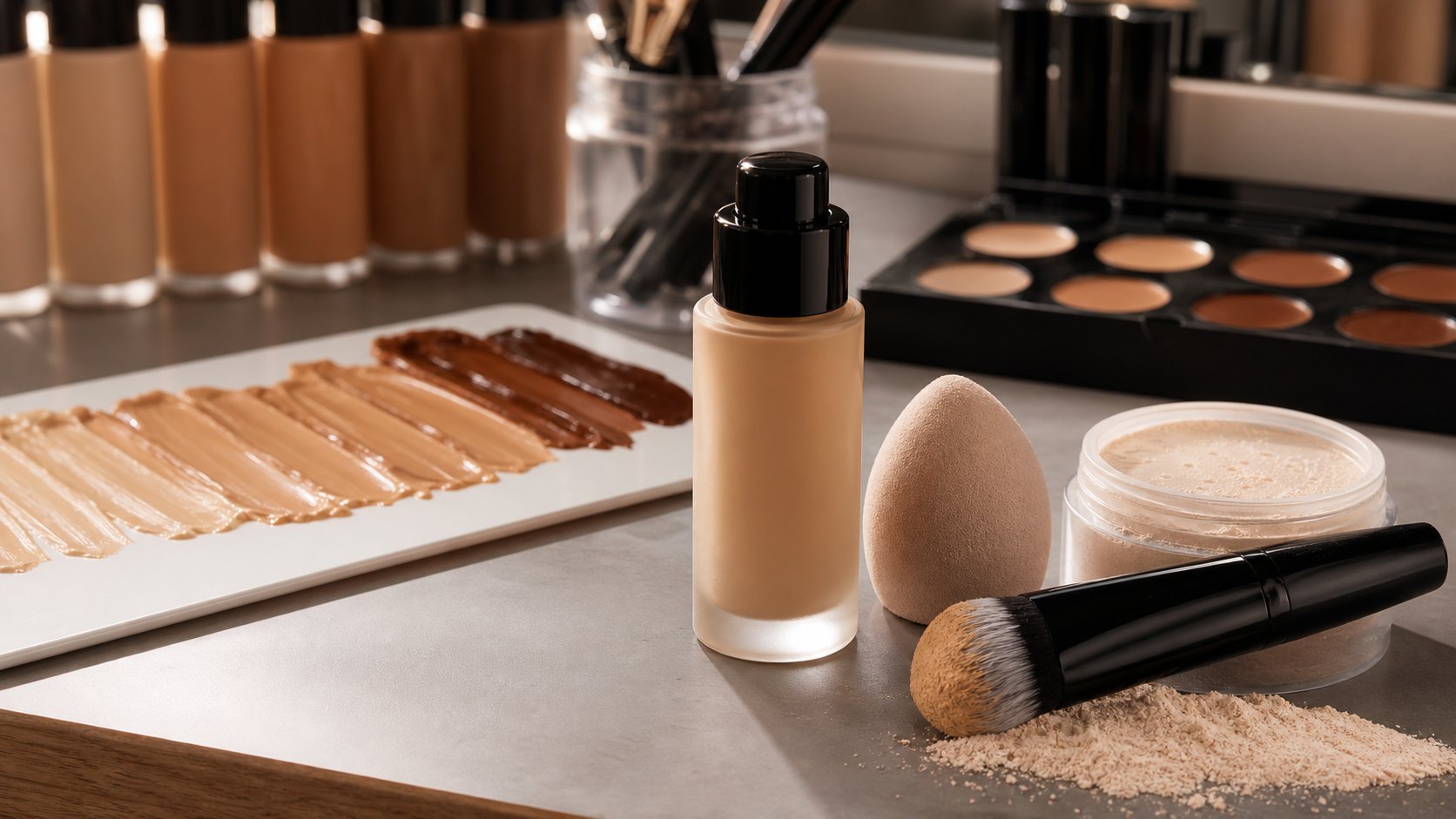
Two launches can both claim range. One stocks cool, neutral, warm and olive at depth and restocks the dark end. The other counts to forty and thins to three warm browns where nuance matters most. The difference shows in sell through by door, not in shade count.
In 2017 Fenty Beauty launched Pro Filt’r foundation in 40 shades, and the number became the new consumer standard for shade count.
That figure reset expectations. Content creator Golloria George said, “I started creating beauty content because I couldn’t find myself in the beauty space,” and added, “An inclusive shade range doesn’t just mean checking off boxes from fair to deep, it means taking the time to understand undertones, depth, and nuance across all skin tones,”. Makeup artist Danessa Myricks said consumers voiced shade feedback more strongly in the wake of the 2020 Black Lives Matter movement. Black consumer spending reached 9.4 billion dollars in 2023, proof that deep shades can bring revenue. The market signal was loud. The response from many brands was a longer menu with a narrow finish.
What the lab can already do
Cosmetic chemist Javon Ford says standard color cosmetic pigments are red, yellow and black iron oxides plus white titanium dioxide, which can cover much of the human skin tone range. Larger manufacturers such as L’Oreal may have access to other pigments like green and blue ultramarine to achieve more diverse undertones, Ford says. He adds that making many smokey eyeshadow browns shows brands can make different browns for foundation, and the outcome depends on the benchmark reference given to research and development. The point lands squarely on planning. A brief that asks for three deep browns gets three deep browns. Ask for depth plus undertone spread and the lab outcome shifts entirely.
Myricks says brands stack ranges with yellow tone and medium shades because many buyers fall in that bucket and brands see more revenue potential there. Myricks also said, “Not every brand can launch 50 shades, 100 shades, 40 shades,”. Budget pressure is real, and a balanced 10 shade range can be workable when the balance is honest. The issue is where balance goes missing. Curology says many brands release only a few warm toned deep shades for the entire Black community, which limits undertone matching as melanin richness rises. The shelf tells that story in miniature. Light and medium arrive with options. Deep arrives as an afterthought.
Undertone explains why count alone misleads. ALS Beauty and Personal Care says skin tone describes visible colour from light to dark and is primarily determined by melanin amount and distribution, while phototype describes response to ultraviolet radiation and tanning. Undertone is commonly classified as cool, neutral, warm or olive and depends on blood vessel visibility, melanin, bilirubin and carotenoid proportion, and light reflection, according to ALS. People with similar skin tones can have completely different undertones. Curology says cool undertones may have hints of red or blue, warm undertones hints of yellow or orange, neutral a mix of both, and olive a neutral type with hints of green or gray. Brand language adds confusion. As a result Curology says what one brand calls neutral could be another brands warm, and shade names like ivory or mahogany can look different across brands. Matching by name becomes guesswork. Matching by undertone spread becomes the test that matters.
A brief that asks for three deep browns gets three deep browns.
What sell through teaches about doors
Retail math decides which shades survive. RepSpark defines sell through as the percentage of inventory sold to consumers over a period, distinct from sell in which is units shipped to a retailer. The formula is sell through percent equals units sold to consumers divided by units received from brand multiplied by 100. Modanomics says sell through benchmarks are above 90 percent sold out, 80 to 90 percent strong performer, 60 to 80 percent healthy, 40 to 60 percent below target, and below 40 percent underperforming. An 80 percent end of season target is common, with basics able to sustain lower sell through with replenishment and seasonal product needing higher early sell through, according to Modanomics.
Foundation shades behave like sizes. RepSpark says a style with 80 percent sell through driven by only a few sizes or doors may need a nuanced buy rather than ordering more of everything. Translation for beauty is direct. A range can look healthy overall while deep shades sit in the wrong stores, arrive in shallow quantities, or never get replenished. Low sales then read as low demand, when the record may show low availability and narrow distribution. The same metric can support opposite actions, reorder winners or cut laggards. Assortment by door, depth of buy by shade, and reorder speed determine whether deep shades get a fair trial.
Colorimetry gives retailers and brands a way to check the work. ALS says colorimetry with analytical instruments provides objective reproducible skin colour measurement and can identify shade gaps in product portfolios. Shade matchers still work by eye and by mix, because visual matching and instrumental colorimetry do not always agree. Brand labels such as neutral or warm differ by brand, and undertone reflects temperature plus physiology and light. Instruments can flag a gap. Only a considered range plan closes it across cool, neutral, warm and olive at depth.
What wear and cost add to the story
Stability is often raised as a reason for caution at depth. A study in PMC investigated discoloration across 32 liquid foundation shades from four global brands, with eight shades per brand from lightest to darkest. Foundations were applied to an opacity chart and colour was measured over eight hours at two hour intervals with a spectrophotometer in CIE1976 L C h colour space. Initial lightness values ranged from 34.05 to 86.50 with a mean of 60.10 and standard deviation of 16.13. Discoloration trends depended on lightness, with darker shades exhibiting less value reduction than lighter shades within each brand. The study notes that foundation pigments are typically insoluble powders including red, black and yellow iron oxides, and proper dispersion prevents flocculation or agglomeration that can harm colour stability. One brand had superior color retention, so stability behavior varies by formulation rather than pointing one way.
Cost pressure sits behind the scenes. Fact.MR values the pigment emulsion market at 16.9 billion dollars in 2025 and projects 38.0 billion dollars by 2035 at a 7.6 percent compound annual growth rate. Fact.MR found 85 percent of stakeholders called increasing raw material prices such as titanium dioxide and acrylic resins a key concern. In the same survey, 72 percent of stakeholders focused on better UV and chemical resistance for colour stability and performance. Pigment coating, dispersion and sebum interaction during wear across skin types remain less documented for deep shades, and the added manufacturing and inventory cost for the last six deep shades versus mid range shades is not publicly broken out. What is known is that large ranges cost more to make, hold and distribute. That burden falls hardest on shades with narrower door counts and slower reorders.
The position that follows is unsentimental. A short deep end is a retail and planning choice, not a lab limit. Standard pigments cover the range. Measurement can find gaps. Revenue exists. Judge a launch by undertone spread across the deepest six shades and by whether those shades stay in stock after the first month. A range that offers olive and cool depth alongside warm depth, names undertones consistently, and restocks dark shades at the same pace as medium shades deserves attention. The rest is counting.

Whitney Doyle
Whitney runs the news desk and the kit guides at Gloss Report. She keeps one spreadsheet of every launch date, restock and shade extension of the year, and can usually tell you the week a blush sold out and the week it came back.
More from Whitney Doyle →