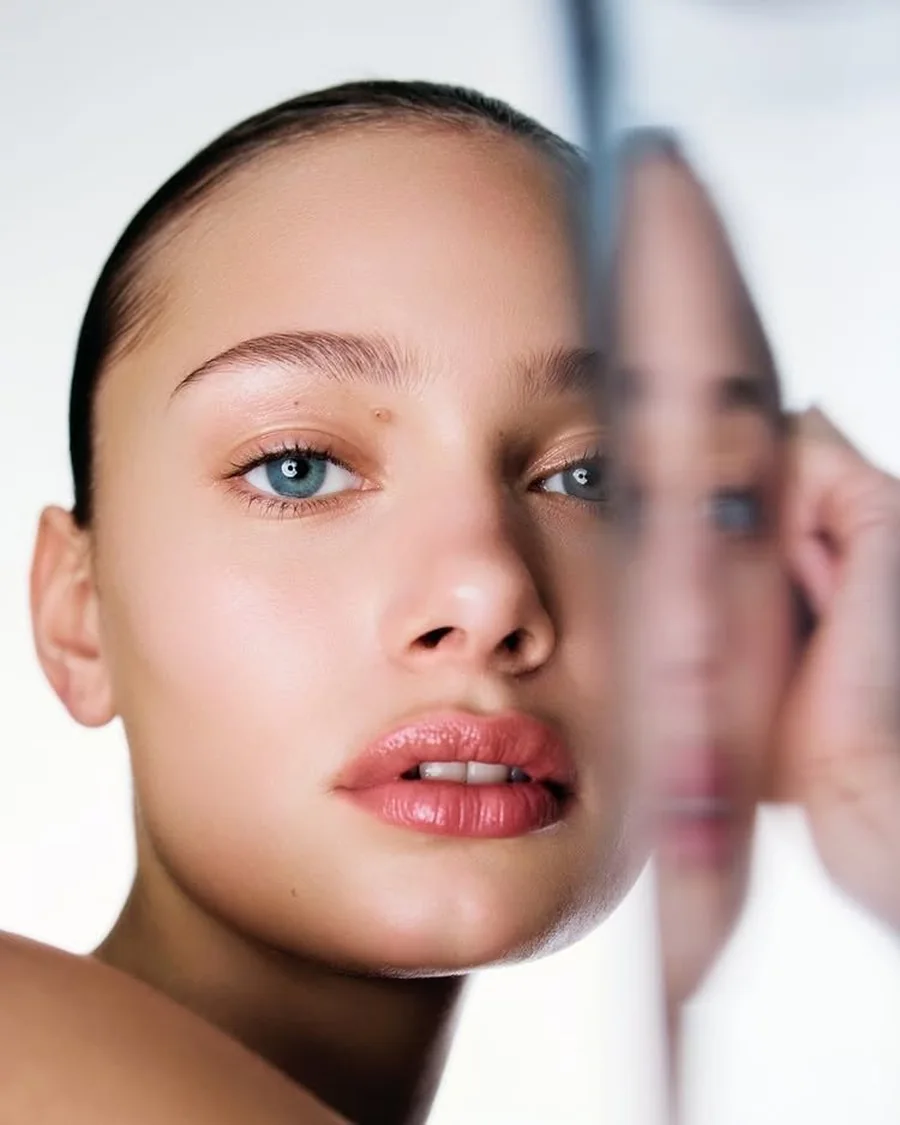
Most foundation mistakes happen at the hand swatch under warm spotlights, and the error only shows at home when the jaw looks orange or grey against the neck. Once undertone is read in daylight and the stripe is left to settle on the jaw, the match holds through photos, workdays and seasonal shifts.
Read undertone in daylight, then beat the store lighting
Undertone is the hue beneath the surface, described as cool pink or blue, warm golden or peach, or neutral balanced, while overtone is the colour first seen. Depth is separate from undertone. A very deep complexion can still be cool, and a very fair complexion can still be warm, which is why choosing by light or deep alone leaves many shoppers outside the range.
Cool skin reads pink, rosy or slightly blue at the jaw and a too warm shade can look orange within an hour. Warm skin reads golden, olive or peachy and a too cool shade can leave a grey cast across the cheeks. Neutral sits between, neither strongly pink nor strongly golden. A catalogue comparison measured 6752 real shades across 106 brands sold at Sephora and Ulta, with 64 percent of shades sitting in the lighter half of the range, so shoppers in the deeper half often find fewer close options and need a more careful read.
Natural daylight has a balanced colour spectrum and reveals the most accurate skin tone and undertones. Warm indoor bulbs can make cooler complexions look overly orange and cool fluorescents or LEDs can make skin appear pale or emphasize dryness and fine lines. Retail floors mix both, plus mirrors with their own tint, which explains why a match made under spots changes by the door.
Start bare faced or with light moisturiser only, near a window around midday. Hold a plain white cloth at the shoulder and look at the jaw, not the hand. One guide reads green veins as warm and another reads green veins as yellow cooler, so Gloss Report triangulates veins with jewelry and fabric checks. Note whether gold or silver looks quieter against the skin, and whether warm peach fabric or cool pink fabric blends better. If the answers point in different directions, neutral or a neutral leaning formula is usually the safer starting point.
The shade finder method samples both cheeks, forehead flat and jaw, discards brightest and darkest pixels, converts to CIE Lab* and compares with CIEDE2000. That language sounds technical, but the logic is useful at home. Sample more than one zone, ignore a bright highlight or a dark spot, and judge the middle tone. Digital shade finder data shows undertone holds up after colour cast correction but depth is only an estimate because phone exposure changes lightness. Use the tool for a shortlist, then confirm on skin.
Swatch from jaw to neck and let it sit
The usual mistake is testing on the back of the hand, which is often darker, redder or more tanned than the face. The jawline is the ideal bridge between face and neck, tested with three vertical stripes from cheek to jawline extending slightly onto the neck. Makeup artist Brittany Whitfield puts it plainly. “I prefer to match clients on the jawline first.”
Pick three candidates that look close in the bottle. One will usually look right under store light and wrong later, which is the point of the test. Swipe each as a vertical stripe from lower cheek over the jaw and slightly onto the neck, then blend the edges lightly without fully buffing away. “When testing foundations, blend a swatch on your hand for a few minutes and walk around the store,” Brittany Whitfield says, and the same pause matters more on the jaw. Swatches should sit for 5 to 10 minutes to account for oxidation when foundation may deepen as it reacts with air and skin oils.
Step outside if possible, or stand by a window. Take a daylight photo facing the light, without flash and without a filter, and check the stripes in the mirror and the image. The shade that disappears into both face and neck is the match, even if it looked dull in the pan. Extend the check to neck and chest when foundation will be worn on bare shoulders or when the neck runs lighter than the face. One artist says match jawline first and not neck exactly, while another method says harmonize face, neck and chest as one canvas, so center face versus neck priority varies. In practice, match the centre of the face for evenness, then blend down so there is no line where face meets neck. When the neck is lighter or has hyperpigmentation, choose the shade that keeps face and neck in the same family and use concealer or light contour only where needed, rather than darkening the whole face to meet the chest.
Transfer and texture show up in this window too. Press a clean tissue once at minute ten. Note whether the stripe lifts heavily or stays put, and whether pores or fine lines look emphasised. A match that is right in colour but wrong in finish will still read as makeup at hour six.
Understand oxidation, dry down and finish
Oxidation is a colour change after application making foundation look darker or more orange, linked to skin pH, natural oils, air, humidity and iron oxides. Brittany Whitfield describes the chemistry in plain terms. “Think of oxidation as biting into an apple and leaving it on the counter for 30 minutes.” Dry down is the foundation drying from wet to drier texture as liquid evaporates, which reveals intended colour and can dry darker, lighter or pinker. The two happen together, so wait before judging.
Water based formulas compared with silicone types are more likely to oxidise because water is harder to stabilise. That does not make silicone better for every skin type. It means a water based skin tint may need a longer test on oily skin in humid weather, and that primer and light moisturising can help by limiting direct contact between oils and pigment, though sources only give general barrier tips. Which exact primer, powder or formula prevents oxidation for each skin type is not shown in the evidence, since sources only give general barrier tips.
Finish changes how the same shade reads. Matte finishes absorb light and minimize shine and texture, luminous finishes reflect light, and mineral pigments scatter light evenly for a soft focus effect. Luminous can make a slightly deep shade look more forgiving at noon and more obvious under evening spots. Matte can make a slightly light shade look flatter by afternoon. Flash photography can bounce off silica or titanium dioxide and cause white cast or flashback, while finely milled mineral powders diffuse light. Check one photo with flash before an event, not only daylight selfies.
Coverage levels matter for the same reason. Sheer lets more skin show through and forgives a near match. Medium balances redness without masking undertone. Full covers most discolouration but shows any undertone error more clearly. Pigment load is the amount of pigment in the formula, and higher load usually means more coverage and a stronger shift if oxidation happens. When between finishes, choose the one that matches the main wearing context, office daylight or evening rooms, and adjust the other with powder or moisturiser rather than buying a darker shade to fake depth.
Mix for seasons, in between tones and sensitive wear tests
Keeping two foundation shades, one for cooler months and one for warmer months, helps maintain match through seasonal tone shifts. One bottle rarely covers February and August. If between two similar shades, professionals blend one tone closer to the face with another matching neck or chest, starting around 1:1 or 2:1 and refining on the jawline. Record the ratio on the phone, because memory slips by week two.
Mixing works best when sticking to very similar consistencies and coverage rather than mixing thick full coverage cream with sheer watery tinted moisturizer. Keep the pair in the same formula family where possible, same finish and same coverage level, so wear time and transfer stay predictable. Colour adjusters fine tune hue without changing texture, with a trace of blue or green if too warm and a touch of yellow or orange if too cool. Use drops, not pumps. Mix on the back of the hand, apply to the jaw, wait the full 5 to 10 minutes, then judge in daylight.
Set the blend so it lasts
Blend down the neck with a damp sponge or brush so the jawline has no edge. Set lightly only where oils break through, usually the T zone, and let the base set before dressing to limit transfer to collars. How long any single shade stays true on oily versus dry skin over eight hours is not fixed, since wear depends on oils, weather and formula. Test the candidate on a normal eight hour day and check at hours two, five and eight for darkening, separation and transfer.
Patch testing belongs in the same routine. A 2026 sensitive skin guide advises applying a small amount behind the ear, along the jawline or on the inner forearm and monitoring for 24 to 48 hours before wider use. A dermatologist home protocol advises reading patch tests at 24, 48 and 72 hours in bright natural light, with reapplication at 24 hours only if no reaction, then testing a small jawline site for two more days. Home patch tests on arm or behind ear cannot guarantee face tolerance and cannot diagnose true allergy, so repeated or spreading reactions need dermatologist testing. Which ingredient causes a specific reaction is also not shown, since home patch testing only screens the finished product. Retest seasonally when switching formulas or finishes, because a summer base with different filters or fragrance can behave differently from a winter one.
The checklist
Sources and further reading
- 7 Expert Ways to Match Foundation to Neck and Chest · bareminerals.com
- Match My Makeup - The Surprising Truth About Oxidation… · matchmymakeup.com
- The Science of Light: Why Your Makeup Looks Different in Every Setting · bellapierre.com
- Foundation Shade Finder — Read Your Skin Tone From One Photo · foundation-shade-finder.com
- Patch testing skincare: the dermatologist protocol for 2026 · getskinscore.com
- Master Makeup Undertones: Find Your Ideal Foundation Match · newconceptbeautybar.com
- How to Find The Perfect Foundation Shade for Your Face · blackopalbeauty.com
For information only, not medical advice. Shade and wear notes reflect our testers' skin; patch test anything new, and check the full ingredient list if you have allergies or sensitive skin.

Whitney Doyle
Whitney runs the news desk and the kit guides at Gloss Report. She keeps one spreadsheet of every launch date, restock and shade extension of the year, and can usually tell you the week a blush sold out and the week it came back.
More from Whitney Doyle →